

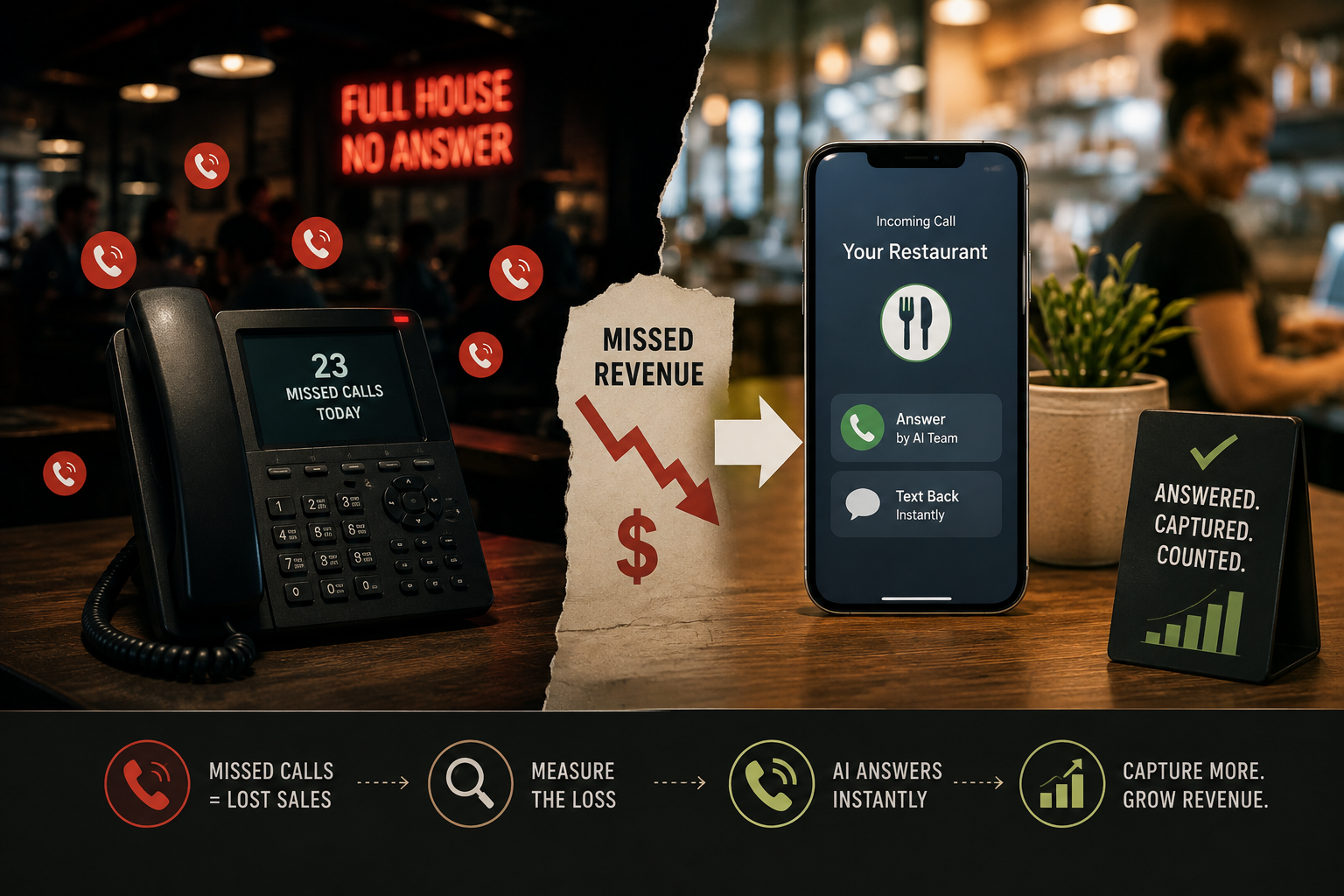
Restaurant phone ordering is the order channel where a guest calls the store directly and a person on the line takes the order by hand. It's also the only channel in your business with no failure log: when nobody picks up, the POS records nothing, the phone bill records nothing, and the loss never reaches a report.
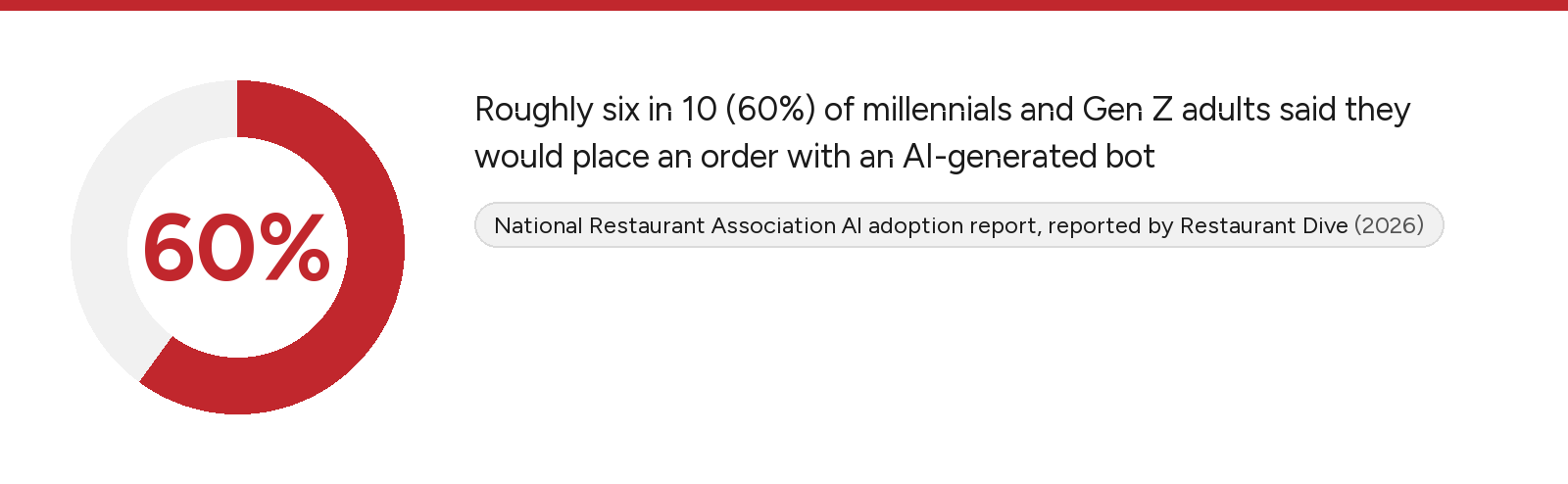 A majority of younger consumers are already comfortable with the idea of an AI voice bot taking their restaurant order, supporting the case for routing missed calls to voice AI. Source: National Restaurant Association AI adoption report, reported by Restaurant Dive (2026).
QSR Magazine puts the industry-wide number at $20 billion a year across 700,000+ U.S. restaurants, with the average location missing about 150 calls a month. Every operator running 50+ units has a version of that number, and almost none of them can name it. This post shows how to size it, then how to fix it.
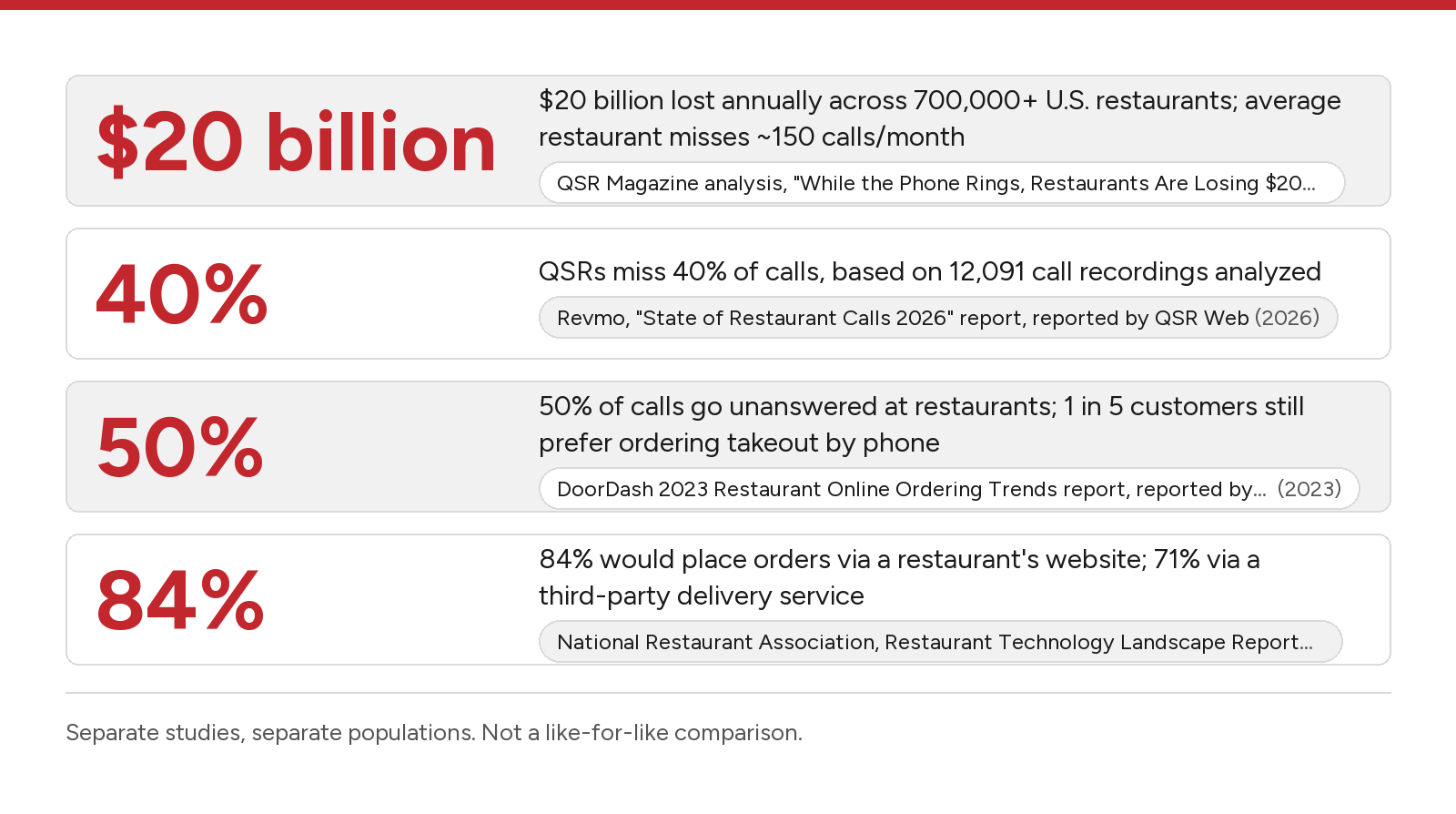 Sources: QSR Magazine analysis, "While the Phone Rings, Restaurants Are Losing $20 Billion" (2026), Revmo, "State of Restaurant Calls 2026" report, reported by QSR Web (2026), DoorDash 2023 Restaurant Online Ordering Trends report, reported by Restaurant Dive (2023), National Restaurant Association, Restaurant Technology Landscape Report 2024.
How do I know I'm losing orders if my POS and phone bill don't show it?
You don't, and that's the problem worth naming first. Your POS reports on orders that were placed. Your carrier invoice reports on minutes and lines. Neither system has a field for the guest who called at 6:40 p.m., got 9 rings, and ordered from a marketplace app instead.
Digital channels made every other order path measurable. An abandoned cart on your website leaves a record. A failed checkout in your app leaves a record. A ring-out leaves nothing, so a phone channel that's failing 40% of the time and one that's failing 4% of the time look identical in your month-end close.
The first fix is instrumentation, not technology. Pull the inbound call detail records from your carrier for 10 representative stores across a full week. Match total inbound calls against calls answered, then overlay your hourly sales curve. The gap between the two lines during your dinner peak is your loss, and it takes a week to produce.
A channel you can't see is running you. Once the number exists on paper, it competes for budget like any other line item.
How many calls go unanswered during peak hours?
Roughly half.
DoorDash's 2023 Restaurant Online Ordering Trends report, found 50% of inbound restaurant calls go unanswered, while 1 in 5 customers still prefer ordering takeout by phone. Revmo's State of Restaurant Calls 2026 report, analyzed 12,091 real call recordings and put the quick-service miss rate at 40%.
Those rates aren't distributed evenly. They cluster in the 90 minutes that generate the most revenue, because the same crew answering the phone is running the line, expediting pickup, and handling the counter.
|
What you can measure today |
What it tells you |
Where to get it |
|
Inbound calls per store per day |
True phone demand, not order count |
Carrier call detail records |
|
Answer rate by hour |
Where the loss concentrates |
Same records, bucketed hourly |
|
Average ticket, phone orders |
Value of each missed call |
POS, filtered by order source |
|
Calls answered after 5+ rings |
Guests who hung on and probably won't next time |
Call analytics or the phone platform |
|
Repeat callers within 10 minutes |
Guests trying twice before giving up |
Carrier records, matched by number |
Multiply your peak-hour gap by your average phone ticket and you have a monthly figure a CFO can act on. Most operators find the answer sits in a range they'd never have approved as a write-off if anyone had put it in front of them.
Is this a revenue problem or a customer service annoyance?
It's revenue, and it converts to a competitor's revenue in about 30 seconds. A guest who can't get through doesn't cancel dinner. They open a marketplace app, order the same food, and you pay commission on an order that would have come to you at full margin. Your phone failure funds someone else's take rate.
The digital-first argument explains why the phone still rings. The National Restaurant Association's 2024 Restaurant Technology Landscape Report found 84% of off-premise customers would order through a restaurant's own website and 71% through a third-party delivery service. That's a strong case for owning your digital channel, and it says nothing about the 20% who still dial.
Owning the ordering experience is its own argument, and we've laid out the cost math behind it separately.
Large-party orders, catering, special instructions, allergy questions, and older guests all route to the phone by default. Those are high-ticket calls. Losing half of them is a four-wall EBITDA problem, not a hospitality nitpick.
Should I route missed calls to voice AI, a call center, or add staff?
Route them off the store. Adding a person to the phone at peak means paying labor to solve a demand-curve problem for 90 minutes and idling that cost for the other 10 hours.
The two options that scale are an off-site call center that answers under your brand's script, and an AI voice answer layer that takes the order and drops it into your ordering system.
Guest tolerance for the AI option is already there. The National Restaurant Association's AI adoption research, found roughly 6 in 10 millennial and Gen Z adults would place an order with an AI-generated bot.
|
Option |
Best when |
Watch for |
|
Off-site call center |
Complex orders, catering, upsell scripting matters |
Per-call cost, brand voice consistency, order entry accuracy |
|
AI voice answer layer |
High volume of short, repeatable orders at peak |
Menu sync, handoff path to a human, POS write-back |
|
More in-store staff |
Single-unit or very low call volume |
Labor % of sales, and the phone still drops when the line backs up |
Remote Restaurant Support handles the call-center path in the OGC portfolio. Whichever route you take, it depends on your ordering system accepting the order cleanly, which is where these projects stall. A voice layer that can't write into your POS creates a second manual entry step, and integration politics decide that outcome long before the vendor demo does.
AI in the phone channel is a real investment, not a later one. The work is making sure it lands on a foundation that carries it: menu data that's current, an ordering platform that accepts a machine-placed order, and a connectivity layer that doesn't need custom middleware per store. That's what an outside review of your restaurant tech stack is for.
FAQ
How do I calculate what missed calls cost my chain?
Take inbound calls minus answered calls for a representative sample of stores over 7 days, multiply the gap by your average phone-order ticket, then annualize. Use carrier call detail records for the call counts and your POS order-source filter for the ticket. One analyst can produce it in a week.
Does call analytics software fix the problem or just measure it?
It measures it, and measurement is the prerequisite. Analytics tells you which hours and which stores are dropping calls; it doesn't answer the phone. Budget for both, and run the measurement first so you can size the answer layer correctly.
Won't guests hang up on an AI voice?
Roughly 6 in 10 millennial and Gen Z adults said they'd place an order with an AI bot, per National Restaurant Association research reported by Restaurant Dive. The failure mode is an order the bot can't push into your system, which sends the guest back to a hold queue.
Where does phone ordering rank against our app and website?
Below both in volume, above both in ticket size for catering and large-party orders. Own your digital channel first for margin, and stop the phone leak in parallel. They're separate cost levers with separate owners.
How long does a fix take to show up on the P&L?
The measurement takes a week. A pilot at 5 stores gives you an answer-rate delta and an incremental-order count inside 30 to 60 days, which is what a CFO needs to approve the rollout.
Where One Goal fits
OGC has vetted 12+ tech verticals across 150+ trusted brands, and phone order capture is one of the few where the operator's own data can't tell them whether they have a problem.
We've run technology stack assessments at 50+ unit operators where inbound call volume and answer rate had never been measured. That's the gap we open with, because a number on paper is what turns a phone line into a budget conversation.
We'll pull the call and answer-rate picture for a sample of your stores, size the loss against your average phone ticket, and put the two or three vetted options for closing it in front of you with the integration work scoped.
Start with a tech stack review and we'll tell you what your phone channel is costing before anyone pitches you a product.
Comments