

Technology spend across a 50-plus-unit restaurant estate goes unaudited because it falls in the gap between IT, finance, and ops. That ownership gap is where the money leaks. It isn't the vendor's pricing that bleeds margin. It's the closed-store phone line still billing, the duplicate circuit left over from a remodel, the delivery-integration seat still active for a franchise partner who left eight months ago, the data plan auto-renewing on a POS terminal you decommissioned 14 months ago.
Technology expense management (TEM) is the practice of finding that spend across the whole stack, telecom, software, and hardware alike, killing it, and assigning someone to keep it dead. This post names what a full audit finds, who should own it, and why growth makes the problem worse before anyone notices.
Who at our company is supposed to be watching these line items?
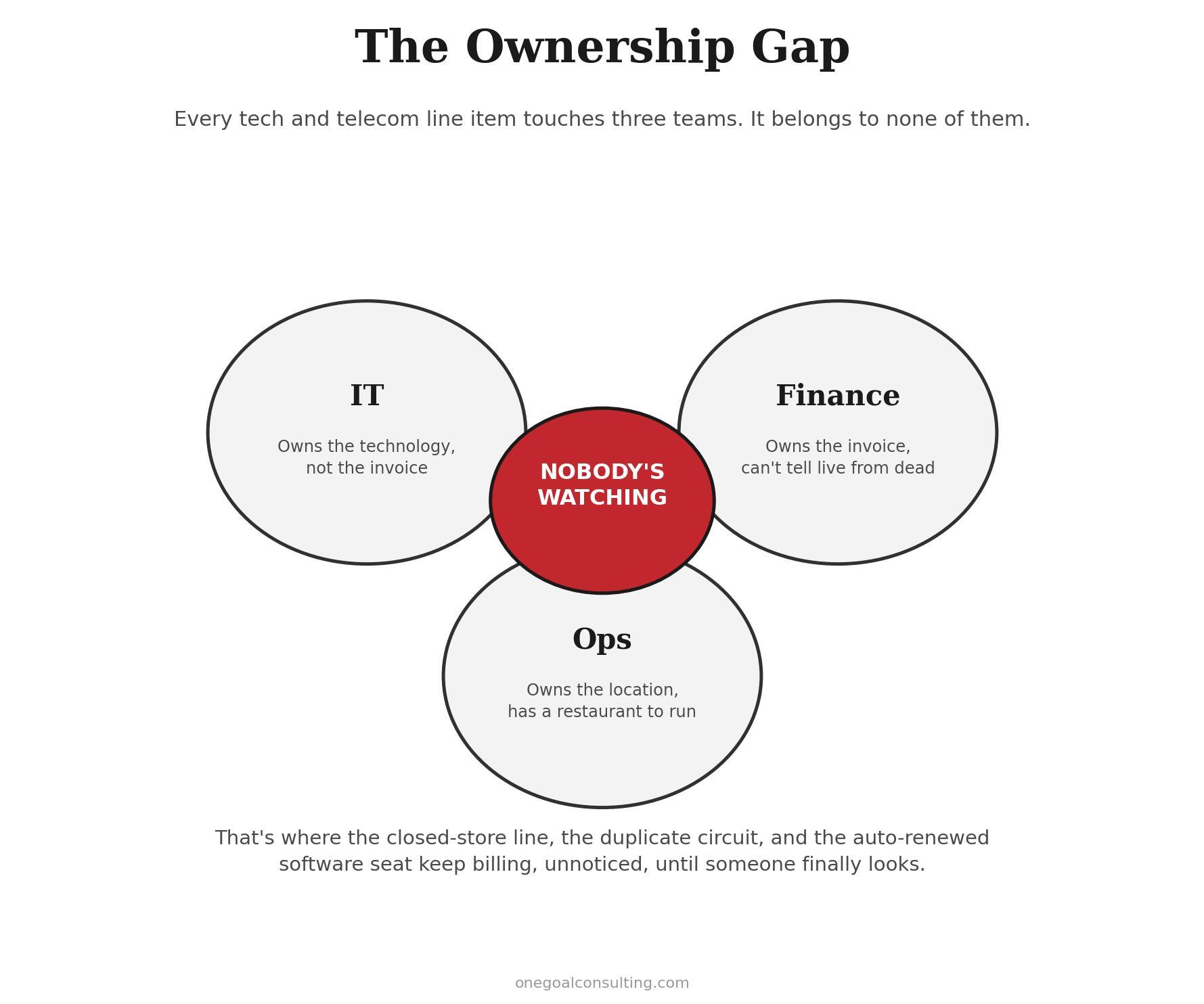
The plain answer at most multi-unit operators is no one, and that's the whole problem. IT owns the technology but not the invoice. Finance owns the invoice but can't tell a live subscription from a dead one, and ops owns the location but has a restaurant to run. Every tech line item, whether it's a phone circuit or a software seat, touches all three teams and belongs to none of them.
So a $180 monthly charge for a phone line at a store you closed in 2024 sails through accounts payable for two years because it's small enough to clear the approval threshold and consistent enough to look legitimate. The same thing happens to a $49 delivery-platform integration fee or a marketing-tool license nobody remembers assigning.
The spend nobody chose is the spend nobody defends. The published stack decisions on this blog, like the real cost math behind Onosys, are purchases someone made on purpose and can explain. Phantom charges are different. There's no owner to ask, so there's no one to catch them, and the waste regenerates every time the estate changes shape, which makes it a governance gap rather than a one-time accounting error.
What does a full technology expense audit find on a multi-unit estate?
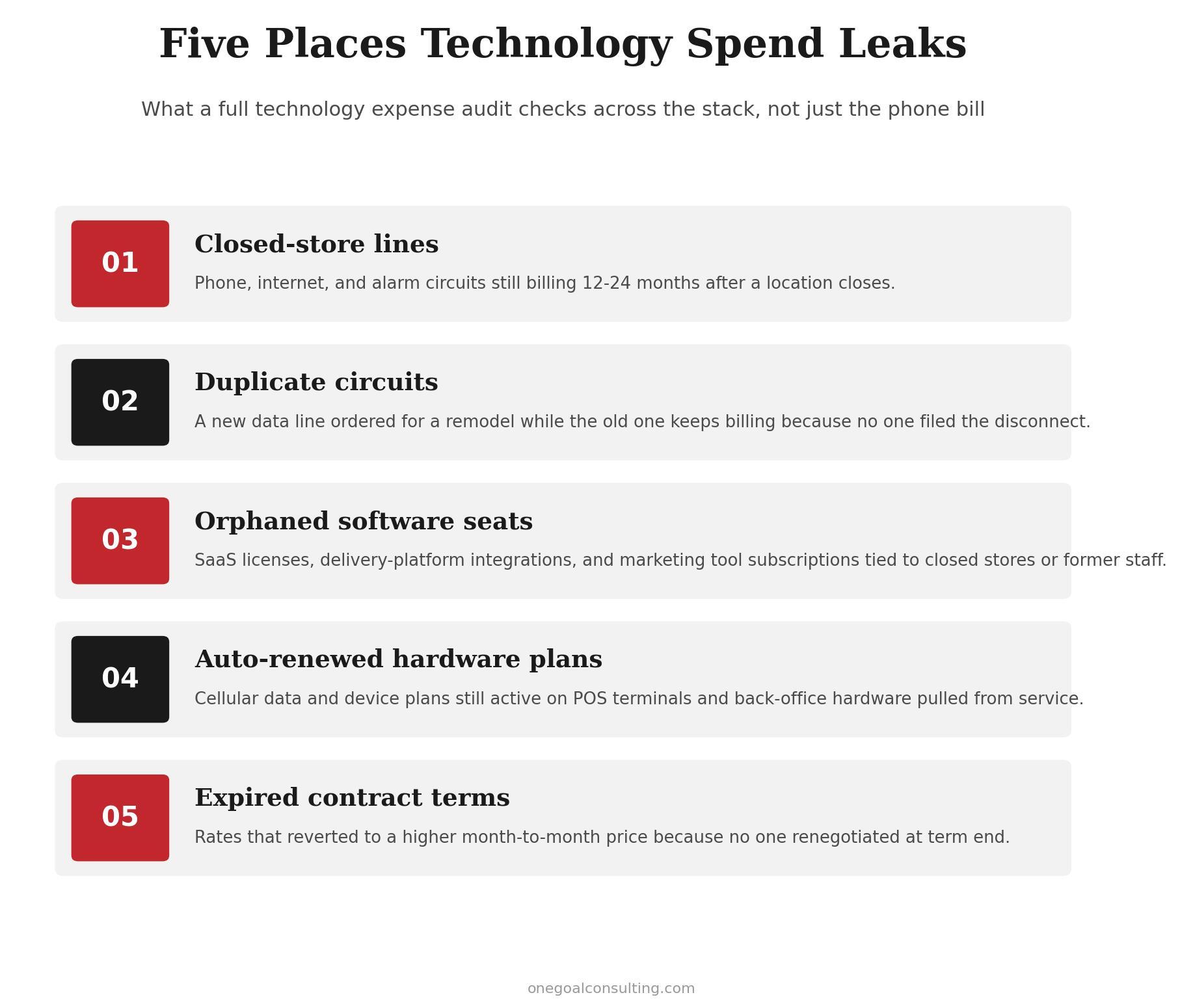
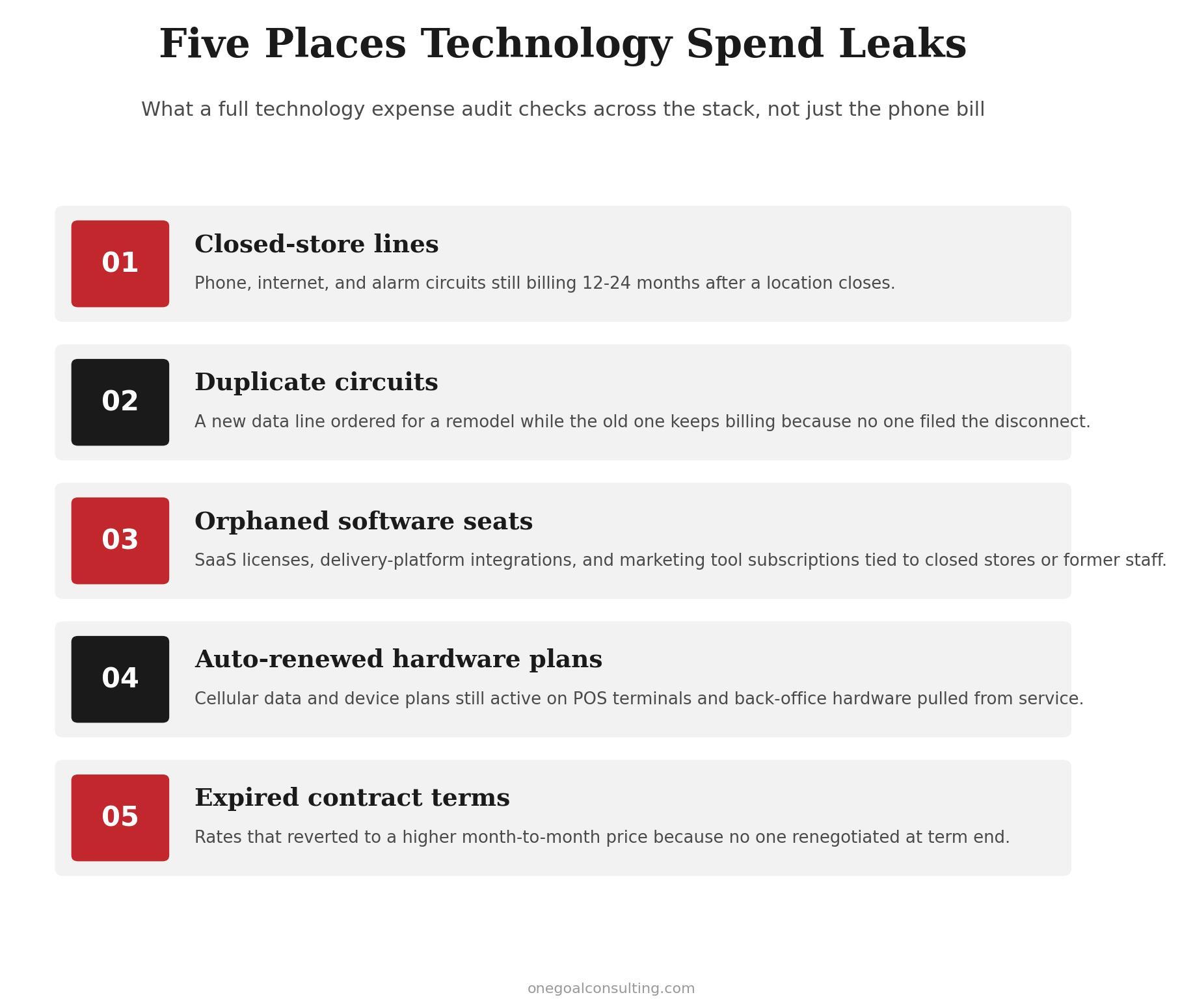
A real audit finds live billing on dead assets, spread across the entire stack rather than just the phone bill. The recurring categories show up in every audit we've run:
- Closed-store lines still billing. Phone, internet, and alarm circuits at locations that stopped operating, often running 12 to 24 months past the close date.
- Duplicate circuits from remodels. A new data line ordered for a refresh while the old one keeps billing because nobody filed the disconnect.
- Orphaned software seats. SaaS licenses, delivery-platform integrations, and marketing-tool subscriptions still tied to closed stores or former employees.
- Auto-renewed plans on decommissioned hardware. Cellular data on POS terminals and back-office devices pulled from service.
- Overprovisioned bandwidth or capacity. Circuits or cloud tiers sized for a peak that never came, or for a system the location no longer runs.
- Contract terms that already expired. Rates that reverted to a higher month-to-month price nobody renegotiated.
This grows because the stack itself grows. The National Restaurant Association's 2026 State of the Restaurant Industry report, reported by Restaurant Business, shows 60% of restaurants focusing tech budgets on customer-experience technology this year, rising to 62% at limited-service brands. Back of house is climbing too: Nation's Restaurant News, citing the 2026 Restaurant Technology Outlook, reports 53% of operators now prioritize POS investment, up from 40% a year earlier.
CHART 1: Restaurant Tech Budgets Keep Expanding
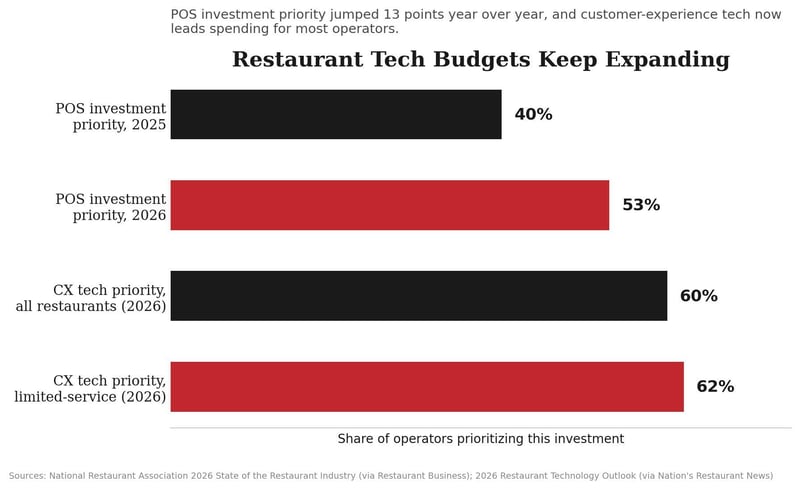
More systems means more line items per location, and every subscription, circuit, and license outlives the hardware or the person it was bought for.
Isn't reviewing vendor contracts at renewal the same thing?
No, and treating it as the same thing is how the leak survives every renewal. Contract review looks at the deals you know you have. Expense management looks at what you're paying, line by line across telecom and software alike, against what's running on the ground.
A renewal cycle assumes the contract is real and the service is in use. It renegotiates price. It never asks whether the circuit or the software license under that contract still connects to a functioning restaurant, which is exactly why the closed-store line and the orphaned seat both survive it. Renewal negotiation optimizes the bills you look at. Expense management finds the bills you don't. This is the same principle behind taking a second set of eyes to your restaurant tech stack: the spend most worth catching is the spend nobody's assigned to question.
How do openings, remodels, and closures create phantom charges?
Every change to the estate creates a service order or a provisioning request, and each one is a chance to add a line without ever subtracting one. Opening a store provisions new circuits, software seats, and integrations. Remodeling relocates or duplicates them. Closing a store should disconnect and deprovision all of it, and that's the step that quietly doesn't happen.
DIAGRAM 1: The Ownership Gap
 The pace of that churn is the reason this matters now. Dog Haus runs more than 50 locations and just signed a 50-unit development deal inside a planned 1,500-unit expansion, per Chain Store Age. Huey Magoo's operates 92 restaurants across 13 states, awarded 60 new development rights to eight franchise groups in 2026, and rolled out a new prototype to lower build costs, according to QSR Magazine. That brand also grew systemwide sales nearly 24% year over year to $163.1 million in 2025, with unit count up more than 20%, per Technomic data reported by Nation's Restaurant News.
A 50-to-100-unit estate can change shape faster in one year than any finance team tracks line by line, and growth doesn't clean up the old spend. It buries it under new spend, so the leak scales with the brand.
Is a full technology audit worth it for a 50-80 unit group, not a 500-unit chain?
It's worth more per unit at 50-80 locations, because you have the same estate complexity with less staff to police it. A 500-unit chain has a telecom and IT analyst watching this full-time. A 70-unit franchise group has a controller wearing four hats and no one watching circuit-level or license-level billing at all.
DIAGRAM 2: Five Places Technology Spend Leaks
Consider what the right partner has already measured. One of our vendor partners saves an operator about $10,000 per new build-out. At the opening pace Huey Magoo's and Dog Haus are running, that's real money captured at the exact moment phantom charges usually get created instead. For the CFO, this isn't new spend to approve. It's spend already leaving the building, redirected back to margin.
Who should own the audit once it's done, so the waste doesn't creep back?
Finance should own the recurring audit and IT should own the deprovisioning trigger, with ops feeding both the store-change signal. An audit that runs once buys a one-time recovery and a slow return to the same leak. The ownership assignment is what makes it stick.
Concretely: every store opening, remodel, or closure should fire a checklist item to reconcile circuits, software seats, and hardware plans, and finance should run a full line-by-line audit on a fixed cadence rather than only at renewal. AI investment sits on top of this cleanly, too. A stack that's inventoried and reconciled is the foundation the next tech purchase gets to build on, which is the same logic behind revisiting your stack in the quiet months.
FAQ
What's the difference between a telecom-only audit and a full technology expense audit?
A telecom-only audit reviews phone, internet, and connectivity charges. A full technology expense audit covers every recurring tech subscription, contract term, and service order across the estate, telecom included. You need the audit to recover what's already leaking and the ongoing practice to keep it from coming back.
How much of the savings drops to the bottom line versus getting eaten by the fixup process?
Most of it, because the biggest recoveries are dead line items with no fixup at all. Killing a circuit or a software seat that bills a closed store costs nothing to fix, and the savings on those go straight to margin. The categories that require renegotiation take work, but the phantom-charge recoveries are pure.
Do we need both a bill audit and full technology expense management?
Yes. The audit finds the backlog of leaked spend across telecom and software. Full TEM stops the estate from generating a new backlog every time you open, remodel, or close a unit. One without the other means you either recover once and leak again, or you govern going forward while leaving years of dead charges on the books.
We're AI-first. Does a technology audit slow that down?
No, it makes the AI spend pay off better. Rising AI investment is real, and an inventoried, reconciled stack is the foundation it needs. Cleaning up phantom charges frees budget and gives you an accurate picture of what you're already running, which is what you want before layering new systems on top.
Where One Goal fits
One Goal Consulting is the intermediary that runs this audit without adding it to your controller's plate. Across 150+ trusted brands and 12+ tech verticals, we've seen where technology spend leaks in a multi-unit estate, from the phone bill to the software stack, and we place the vetted partners who recover it and keep it recovered.
Founder Matt Haselhoff spent 27 years in restaurant technology, including as CRO of Omnivore through its acquisition by Olo, so we know what a service order does to a bill when nobody owns the deprovisioning step. The first step is concrete: we'll pull one month of your technology invoices against your live location list and show you the lines that shouldn't be there.
Book an audit with One Goal and we'll map out the savings opportunities that exist for your brand.
Comments