


Third-party delivery fees deserve an audit that follows each order through to the cash received. A commission rate tells you only part of the cost. Promotions, refunds, adjustments and other deductions need their own review, by location and platform. If month-end close ends when the bank deposit matches the payout statement, the next step is checking whether the deductions behind that payout were correct.
That review starts with your own records. An industry survey can establish why delivery economics deserve attention. It can't tell you whether your restaurants have been overcharged, whether a refund was justified or how much you could recover.
The useful question for a CFO is concrete: can finance explain what came out of delivery revenue, why it came out and who checked it?
How much do third-party delivery fees cost a restaurant?
Use your agreement to establish the commission, then reconcile the deductions and credits on the statement. There isn't one rate that applies across every location, package and contract. The survey below describes reported fees; it doesn't replace your negotiated terms.
Calculate statement deductions as a share of the sales base you've defined, with the numerator and denominator recorded. Then assess order contribution after food, packaging, attributable fulfillment labor and channel charges. A fee rate helps explain the statement. Contribution shows whether those orders cover the costs included in your analysis. Keep customer-paid charges separate from the restaurant's expense.
What does the commission rate leave out?
The commission rate leaves out every cost or adjustment that sits outside its calculation. An audit needs to separate those items before anyone can judge the channel’s contribution.
The National Restaurant Association’s May 2026 submission to the FTC offers a reason to take that work seriously. In its preliminary survey of 830 restaurants offering third-party delivery, 45% said those orders weren't profitable. Two in three respondents reported an average platform fee between 15% and 29.9%.
The sample covered full-service and limited-service restaurants. It wasn't an enterprise-chain-only study, and those reported fees aren't a benchmark to apply automatically to your contracts.
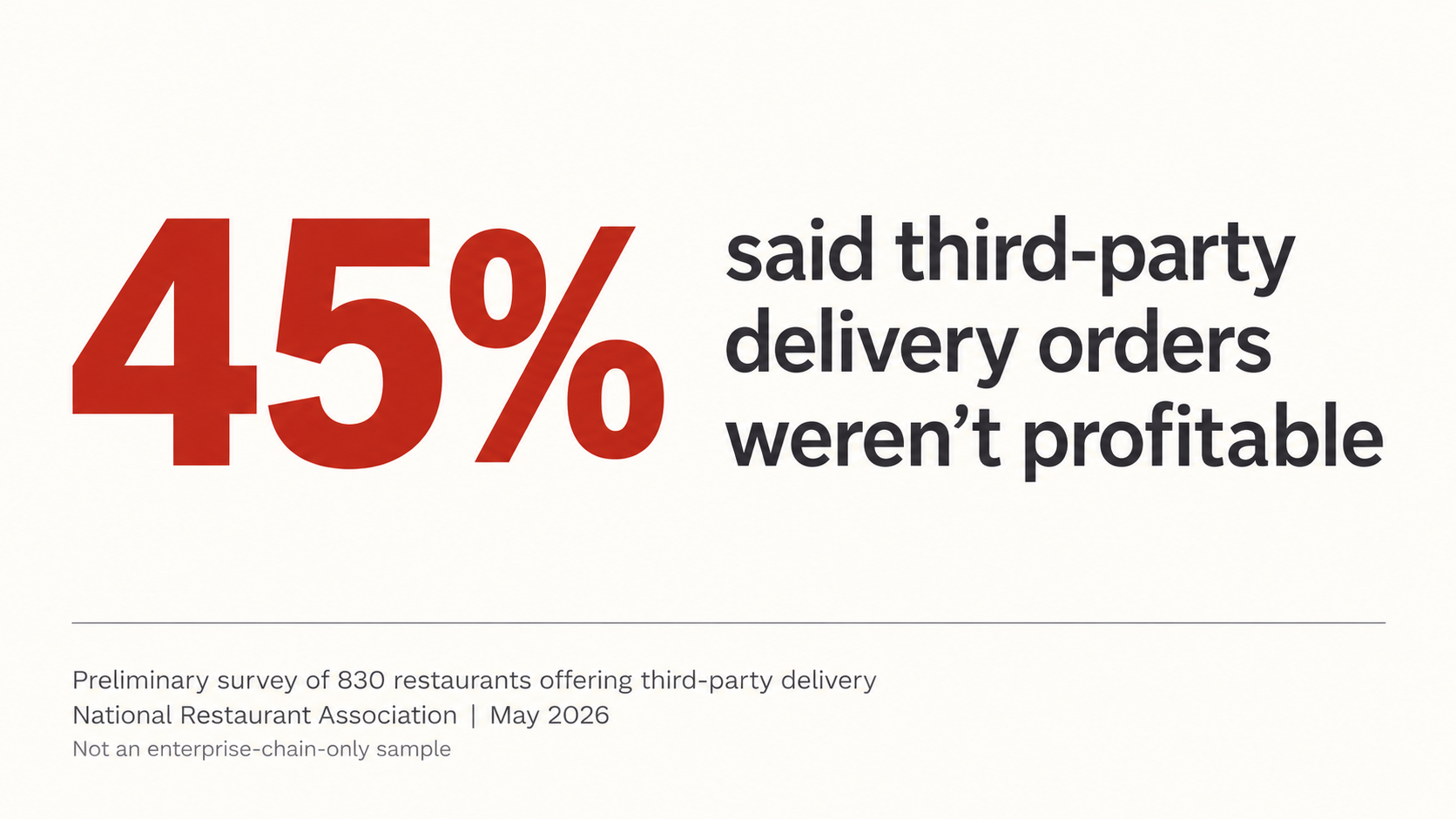
45% of respondents said third-party delivery orders weren't profitable. Preliminary survey of 830 restaurants offering third-party delivery, National Restaurant Association, May 2026. The sample wasn't enterprise-chain-only.
For a restaurant group, the practical response is to build a view that separates:
- Commission: the contractual charge and the sales amount used to calculate it.
- Promotions: the restaurant’s contribution to discounts or offers.
- Refunds and chargebacks: amounts deducted, their stated reasons and their disposition.
- Other fees and adjustments: individually identified charges and credits.
- Net payout: the amount remitted after the statement’s deductions and credits.
Keep packaging and other internal fulfillment costs in the channel profitability analysis. They belong in the economics, but they should remain distinguishable from deductions on a marketplace statement.
That separation gives finance 2 useful answers: whether the statement reconciles and whether the orders produce an acceptable contribution after costs. A correct payout can still come from an unprofitable channel.
How should finance reconcile the statement?
Finance should reconcile the statement at the location and platform level, using a defined period and a documented treatment of timing differences.
Begin with a completed statement period. Assemble the applicable contract, order records, payout detail, promotion terms and refund or dispute records. Record any gaps before drawing conclusions. Missing detail is a reason to investigate, not proof that money is owed.
The audit should answer a short sequence of questions:
-
Do the orders match? Connect statement entries to the underlying order records wherever the available data allows.
-
Does the commission calculation match the agreement? Check both the rate and the amount to which it applies.
-
Can each promotion deduction be explained? Identify the offer, the approved funding arrangement and the period it covered.
-
Can each refund or adjustment be traced? Preserve the reason, supporting record and any later credit.
-
Does the payout reach the bank? Account for settlement timing and unresolved differences.
Use an exception log for items that can't be explained. Record the location, platform, statement period, order or adjustment ID, deduction type, recorded amount, contractual basis, evidence, owner, next action and status. Track amounts disputed, credits confirmed and cash received separately. This is a proposed review template; an unexplained deduction still needs investigation before anyone calls it an overcharge.
Keep disputed amounts separate from confirmed credits. Keep confirmed credits separate from cash received. A claim submitted for review isn't recovered revenue, and a credit already recorded shouldn't be counted again when it reaches the bank.
The first review may establish that the charges are correct. That's a useful finding. It gives the controller a defensible baseline and prevents an unsupported recovery estimate from becoming a budget assumption.
Why review each market and contract separately?
Each market and contract needs its own review because one restaurant group can operate under different commercial terms and local requirements.
The New York City restaurant delivery-app guidance describes jurisdiction-specific caps and protections. That local framework illustrates why a national restaurant group should preserve market detail in its audit. It doesn't establish a national fee rate.
Build the review file around the agreement that applies to each location. Include its effective dates, amendments and the relevant market. An unexplained difference between 2 stores should prompt a check of those records before it's labeled an error.
Customer-facing fees also need to remain distinct from restaurant charges. In April 2026, the Federal Trade Commission sought public comment on online delivery fee practices. Its questions addressed matters including total price, fee purpose, refundability, contingent charges and item-price differences.
That request concerned whether a rule was needed, primarily around customer-facing transparency. It wasn't a final rule governing restaurant commissions.
For the statement review, use precise labels. A customer delivery charge, a restaurant commission and a refund adjustment describe different transactions. Combining them under “delivery fees” makes the total harder to explain and the exceptions harder to resolve.
What makes delivery auditing worth continuing?
A recurring audit earns its place when its confirmed financial benefit and operational value justify the cost of doing it.
Track the work as carefully as the deductions. Record staff time, external fees, confirmed credits, cash received and unresolved items. Evaluate any proposed delivery expense support against that baseline.
A credible evaluation should establish what records are required, who reviews exceptions, who submits disputes and how outcomes are reported. Finance should also understand how charges for the service affect the amount the restaurant retains.
Avoid turning the first unusual statement into an annual recovery forecast. Establish whether the issue repeats, whether it affects other locations and whether the underlying cause can be corrected.
The review can also inform channel decisions. Once delivery costs are visible, compare the economics with other ordering paths using their full costs. The related article on direct ordering cost math provides context for that broader assessment.
Keep each improvement measurable. Confirmed reductions in delivery expense can help fund the next cost review, but each step needs its own evidence and business case.
Where One Goal fits
One Goal Consulting helps restaurant groups assess technology against a defined business need. Its portfolio includes delivery expense support, making statement reconciliation a concrete starting point for an evaluation.
We help assess fit against the work your team needs covered, with your statements establishing whether there's a financial case.
If the review finds no material discrepancies, that conclusion should stand. If the workload is the problem, the evaluation should measure the time required alongside any confirmed recoveries.
The forward-looking goal is a repeatable close process: delivery deductions have clear categories, exceptions have owners and finance can explain the cash received by location.
Book a consultation with a recent marketplace statement and the applicable agreement. Start with the charges your team can't explain and the work required to resolve them.
Comments