


When evaluating a restaurant technology consultant or matchmaker, ask for the reasoning behind the shortlist: which cost it addresses, why each company fits, what commercial relationships sit behind the introduction, and what your team still needs to verify. For a finance or technology leader responsible for 50+ locations, that record belongs alongside the quote. A recommendation becomes useful when the buyer can examine its scope, evidence and full cost.
The familiar buying process starts with whoever reaches the inbox. Each sales team explains its own product. The restaurant team then carries the work of comparing claims, finding gaps and deciding which conversations deserve time.
An intermediary can carry some of that evaluation work. The buyer still needs a clear basis for trusting the intermediary.
What work should a restaurant technology consultant cover?
Define the deliverable before comparing proposals. Requirements analysis, vendor screening, introductions, implementation and ongoing support each need an assigned owner. A consultant's title doesn't establish which of those jobs their engagement includes.
Ask for the written output, the commercial relationships behind recommendations and the handoff after selection. If your team needs someone to configure connections or manage a rollout, put that responsibility in the scope. An introduction alone doesn't settle who will perform the work. This gives a multi-unit buyer a way to compare engagements with different responsibilities.
What should a matchmaker know before recommending anyone?
They should understand the expense being examined and the restaurant’s requirements before naming a company.
“Reduce telecom expense” is a starting point. A useful brief goes further: which locations are in scope, what the current contracts cover, when those agreements renew and who owns the decision. For delivery fees, start with marketplace statements and adjustments. For energy consumption, utility bills establish the baseline.
This discipline matters in a difficult financial environment. The National Restaurant Association’s 2026 industry outlook describes persistent cost pressure and uneven traffic, alongside intentions to invest in technology that improves efficiency and guest connections. That supports careful investment. It doesn't establish that a particular product will improve profit.
The matchmaker’s recommendation should connect the proposed capability to the specific expense under review. “This company serves restaurants” leaves too much unanswered. A buyer needs to know why its offering belongs in this particular evaluation.
A useful written introduction should explain:
- The cost lever and the records needed to assess it.
- The requirements that make the proposed company relevant.
- The known constraints that could rule it out.
Those constraints deserve space early. A contract obligation, an integration dependency or the work required from store teams can change whether an otherwise credible recommendation fits.
How do you assess a matchmaker's neutrality?
Judge neutrality through the scope of the search, the explanation of commercial ties and the willingness to identify a poor fit.
The word “neutral” alone can't establish any of those things. A matchmaker can maintain a defined portfolio and make useful introductions. The buyer should understand where that portfolio begins and ends.
Start with a direct question: Which options did you consider, and which could you recommend?
The answer should distinguish between companies the intermediary represents, companies it knows about, and companies it has evaluated. A shortlist drawn from a portfolio should be described that way. Buyers should also know what happens when none of the available choices meets their requirements.
The next question concerns compensation: Does this introduction create a financial benefit for you, and how does that relationship work?
The FTC’s Endorsement Guides FAQ gives a relevant disclosure principle. When a recommendation is an endorsement, an unexpected material connection to the seller that could affect credibility should be clearly disclosed. The guidance also explains that vague language about working with vendors may not adequately explain a financial connection.
For a restaurant buyer, the practical takeaway is to seek a plain explanation of the relationship behind a recommendation. Compensation arrangements should be understood before the shortlist becomes a purchasing decision.
A credible intermediary should also be able to explain where the fit breaks down. That gives both sides useful information. The restaurant avoids pursuing an unsuitable purchase, and the seller gets a clearer view of whether the opportunity matches its capabilities.
What does “vetted” need to mean?
“Vetted” needs a stated scope, supporting evidence and a clear account of what remains for the buyer to verify.
A commercial assessment and a security assessment answer different questions. A company’s experience serving restaurants doesn't, by itself, establish how its product handles data or how resilient its service will be.
NIST’s supplier due diligence guidance, SP 1326, defines due diligence around researching pertinent information before acquiring or continuing to use a supplier or product. Within its information and communications technology scope, it covers areas including provenance, resilience, foundational cybersecurity practices, ownership and control, and supply-chain tiers.
This ICT risk guidance isn't a restaurant purchasing standard. It provides a useful reason to ask precisely what an intermediary’s screening covered.
The buyer should be able to separate:
- What the matchmaker checked.
- What the seller supplied as evidence.
- What the restaurant’s finance, IT or operations team still needs to validate.
For integration overhead, for example, the recommendation should leave room to examine dependencies, implementation charges and ongoing support responsibilities. A claim of fit should survive those questions.
A useful introduction also makes ownership clear. Screening and introducing a company doesn't establish that the matchmaker will execute the pilot or manage the rollout. Those responsibilities need to be assigned explicitly.
What should the recommendation record include?
Ask for a concise recommendation record that your team can challenge using its own requirements and records.
Use these fields in the recommendation record: expense and locations in scope; required capabilities and connections; companies considered and why each fits; portfolio limits and commercial ties; evidence checked and evidence still needed; implementation owner and full cost. Ask the intermediary to complete the record before your team commits to demos. A blank field identifies a question to resolve.
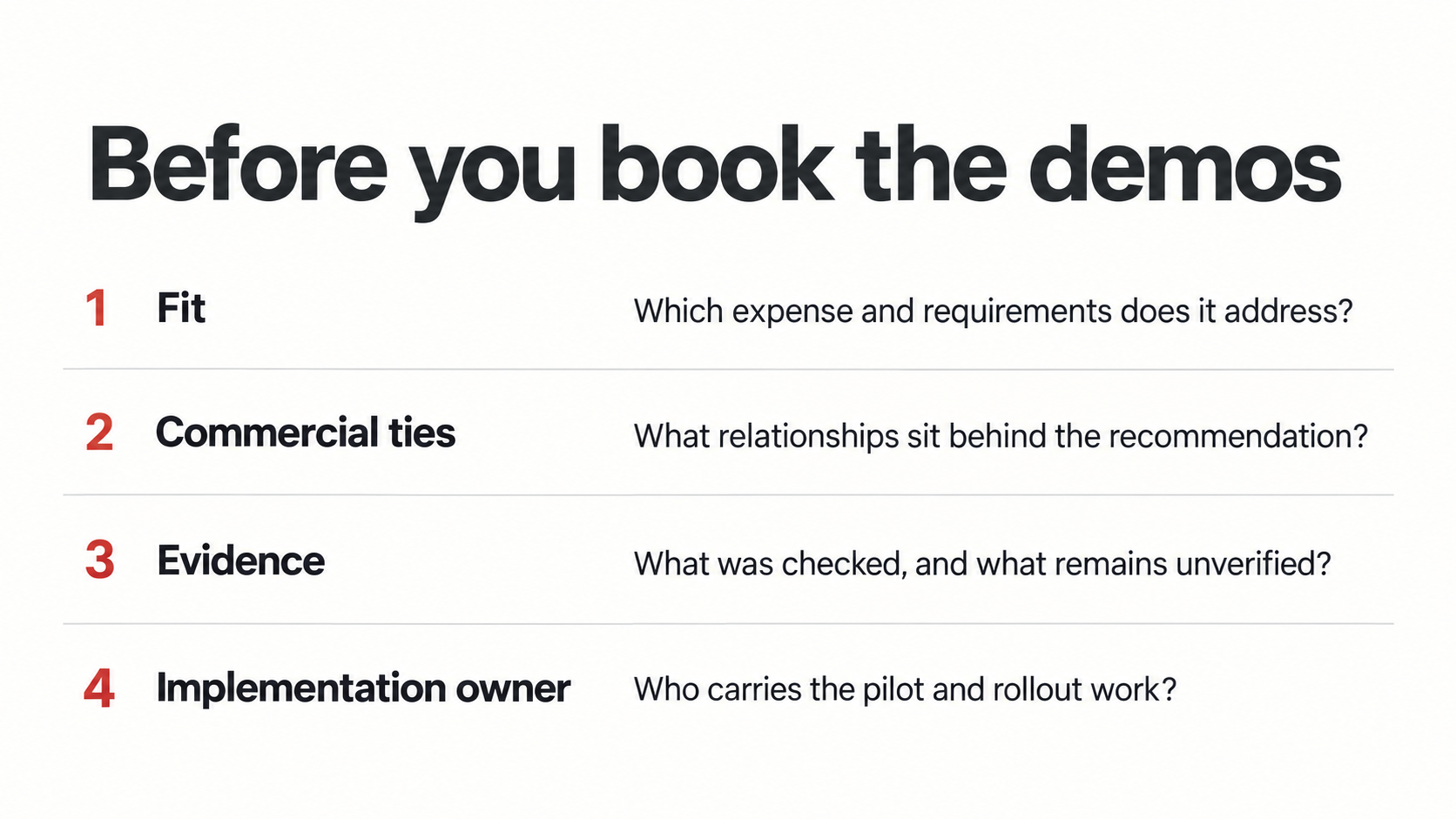
Above: Four checks to record before committing to demos. Proposed buyer checklist.
Keep the projected benefit separate from the full cost. A telecom proposal, for example, needs to account for relevant contract obligations and implementation charges before a lower recurring bill becomes a defensible business case.
The same discipline applies when several purchases are being considered. Savings from one change can help fund the next when they have been verified and are available. Until then, projected reductions remain assumptions in the budget. Combining several forecasts doesn't make them realized results.
Our guide to evaluating restaurant technology covers the purchasing process in more detail. The intermediary’s contribution should make that process easier to carry out. Where a pilot is appropriate, setting its metric and measurement window before launch gives the restaurant and the seller a shared basis for judging the outcome.
Where One Goal fits
One Goal Consulting connects restaurant executives with a vetted technology portfolio. Its company overview reports 150+ trusted brands. That experience is a reason to begin a conversation; each recommendation still needs a clear explanation of fit.
We help with the assessment and introduction, with pilot execution and rollout owned by the selected vendor.
The next useful step is to bring one expense category, the relevant records and your requirements to a consultation. Include questions about portfolio coverage, commercial relationships and what your team will need to verify.
Over time, each technology decision should leave behind a better record for the next one: what was expected, what it cost and what changed on the bill. A matchmaker earns continuing trust when their recommendations help build that record.
Comments